23 Jun Video Surveillance Laws by State
Surveillance technology is a valuable tool for commercial property owners and managers. The right installations and management software keep professionals informed about the activities taking place near employees, assets, company vehicles, and equipment.
One might think video and audio surveillance is permitted everywhere. This is not the case. Some locations in the United States have distinct rules about where cameras can be placed.
Understanding Video Surveillance Capabilities and Consent
Video surveillance systems enable teams to track movement, identify faces, capture license plates, catch out-of-the-ordinary behaviors, and more. Property owners commonly position cameras in places where they go unnoticed or are unseen before entering a space, indoors or outdoors.
Many states allow video recording in nonprivate locations, which abides by federal regulations. This eliminates privacy concerns, as businesses are not permitted to record footage in places like bathrooms, hotel and motel rooms, or fitting rooms. Any footage gathered illegally, no matter the intent, is not valid upon entering a courtroom.
Video Recording Consent
While the Fourth Amendment does not specifically mention laws for surveillance cameras, the legislation relates to privacy and the ethical behavior of law enforcement. The Fourth Amendment focuses on protecting Americans from unreasonable searches or seizures. U.S. courts consider the details of federal regulations to determine when businesses are using these technologies lawfully. Outcomes change based on state laws and situations.
Public places are acceptable locations for video recording without audio. Examples include parks, parking lots, shopping malls, financial institution lobbies, and any place in which individuals entering have little to no expectations of privacy.
Audio Recording Consent
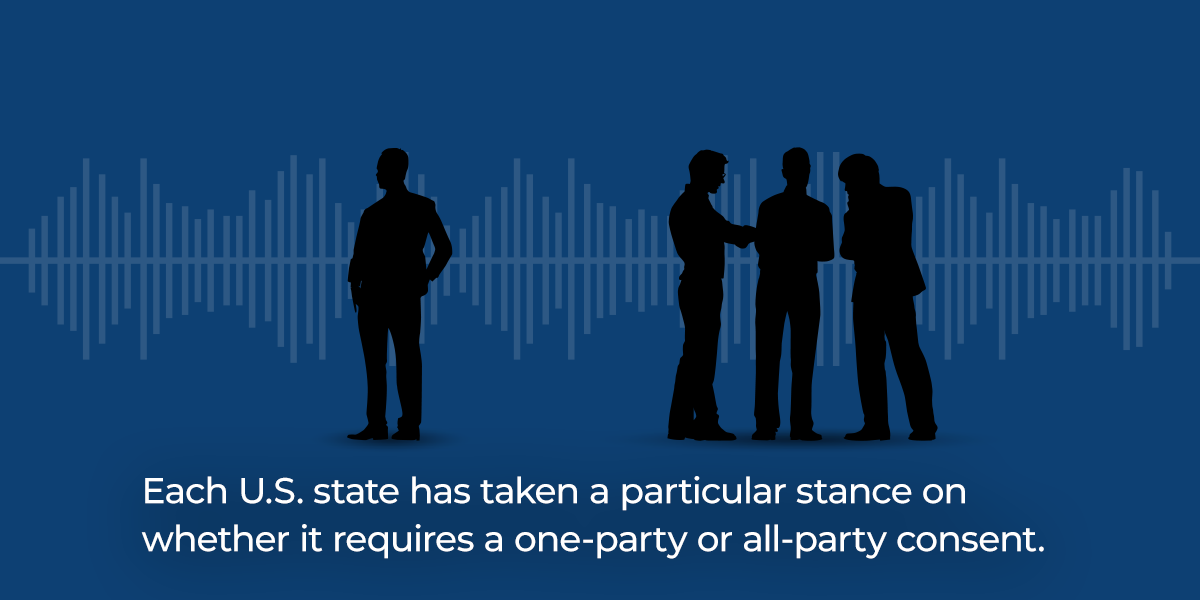
Security camera laws for audio are drastically different from video. The Electronic Communications Privacy Act (ECPA) outlines how businesses can capture and utilize audio recordings for surveillance purposes. Each U.S. state has taken a particular stance on whether it requires a one-party or all-party consent.
One-Party Audio Consent
The one-party consent structure describes a situation in which two or more parties are involved in a conversation. When one of the parties agrees to the audio recording, the activity is deemed lawful. The opposite person does not need to be notified when audio is being recorded. This rule applies to audiovisual recordings and phone calls.
States following the one-party approach are:
- Texas
- Ohio
- New York
- Alabama
- South Dakota
- Alaska
- West Virginia
- Utah
- North Carolina
- Iowa
- Wyoming
- Mississippi
- Arizona
- New Mexico
- Kentucky
- Kansas
- Virginia
- Oklahoma
- Missouri
- Louisiana
- Colorado
- Rhode Island
- Georgia
- Indiana
- Tennessee
- North Dakota
- Arkansas
- Idaho
- New Jersey
- South Carolina
- Nebraska
- Michigan
- Wisconsin
- Minnesota
All-Party Audio Consent
An all-party consent structure demands that each person involved in an audio recording agrees to the activity. All participants are aware they are being recorded. All-party consent laws for surveillance cameras require businesses to explore their state’s existing regulations. Falling short of compliance in this area can result in criminal charges, so it is vital to research local laws before selecting surveillance equipment and utilizing all features.
Note that these states follow an all-party consent view:
- Washington
- Montana
- Illinois
- New Hampshire
- Florida
- California
- Maryland
- Delaware
- Pennsylvania
- Massachusetts
Mixed Audio Consent
Some states follow one of the consent structures above, but with unique nuances. These situations revolve around digital communications versus in-person interactions. Support for this approach comes from the idea that an individual may behave or speak differently using digital communication methods.
Only a handful of states operate with a mixed audio consent structure:
- Connecticut: Requires one-party consent for in-person surveillance and all-party consent for audio only.
- Hawaii: Deems that a party can record audio without asking, but the practice cannot take place in private settings.
- Maine: Follows a one-party consent structure, except when recordings are for criminal purposes or in private places.
- Nevada: In-person communications require one-party consent, and audio-only scenarios demand all-party consent.
- Oregon: Calls for in-person audio recording consent from all parties, but audio-only calls need one person’s consent.
- Vermont: No state law is set, so it defaults to one-party consent for audio and all-party consent for audiovisual.
Complying With Video Surveillance Laws by State
Remember that laws regarding security cameras and audio are constantly changing. Make sure you do your part to operate legally by researching government websites for the state you work in. Pay attention to requirements for consent, which could include obtaining recorded verbal consent or getting consent in writing.
Keeping employees informed about the installation of workplace cameras and posting signs that read “Recording in process” are effective ways to start your surveillance efforts off on the right foot.
Optiview Offers Video Surveillance Solutions Supporting Your State’s Laws
Optiview has worked in the surveillance industry for 20+ years. We bring you innovative surveillance cameras, recorders, access control systems, and related technology for surveillance dealers and integrators. All of our products undergo strict testing and can be customized to meet your needs.
Our team provides free tech support and will recommend items for a setup once we learn more about your industry and work location. We provide solutions for both one-party consent and all-party consent states.
Speak With Us About Your Surveillance Project
The team at Optiview wants to help you find the indoor and outdoor surveillance equipment you require for success.
Contact our experts to get started with your project today.