
30 Apr Cybersecurity and Physical Security Convergence
Security convergence seeks to integrate cybersecurity and physical security. Data breaches and security threats are top key concerns for businesses and organizations. Formerly, these two practice areas were run separately, but threat actors see penetration of a business as a single continuum from systems to physical plant.
As the network of integrated systems via the Internet of Things (IoT) we see a convergence of devices poised to manage both physical and digital security. The clear benefit of security convergence allows for a comprehensive and ultimately cost-effective approach. A converged security strategy shares threat alerts and allows for collaboration between teams and equipment.
What Is Security Convergence?
Security convergence thinks about physical security and cybersecurity at the same time to allow for effective planning of both teams and equipment. The benefits of the integration of cybersecurity with physical security are to:
- increase protection
- use human intelligence more effectively
- save costs through synergy in equipment and people
Security convergence combines the safeguarding of physical assets, through access control, video surveillance, and software with the protection of digital assets like computers, networks and systems.
This is possible because physical systems rely evermore on both internet connectivity and internet protocols to integrate with local networks of security devices and sensors. These operate on software systems on either cloud-based or local servers. As a result, cyber threats can penetrate the system through the physical security devices and vice versa.
The changes in the way businesses work, together with greater use of public cloud, highly connected supply chains, and use of cyber-physical systems, allow for novel attack strategies. Often, third-party vendors are used to provide monitoring services or software services that open the combined network to a larger threat set.
Security convergence covers both the physical security and cyber security teams to secure critical assets. While the two teams often don’t merge, they can communicate and collaborate to bring cloud-based systems and physical systems together for optimal security. In this way, an organization is best and most economically prepared to respond to blended threats, create a robust security strategy, and simplify threat responses that all create competitive business advantages as benefits to security convergence. Teams that communicate and collaborate more provide a holistic approach to security that is stronger and more cost-effective.
Challenges of Integrating Cyber and Physical Security
Companies and organizations that wish to integrate cybersecurity and physical security systems face a host of challenges, including:
- integration of disparate and numerous software platforms
- integration of disparate and numerous physical security equipment and platforms that, in turn have subsets of software that drive them
- integration of network architecture, budget constraints, role confusion, skillset issues, communication challenges among teams
Due to the high accuracy of physical security equipment, users will need to develop standards around monitoring, facial recognition, and the like. Fortunately, more advanced algorithms can provide this control at the equipment level, or the software level and assist users to make sure polices are adhered to.
Challenges mount when users need to address multiple locations or resolve problems that touch multiple teams. Users will need to clarify roles and disperse confusion integrating people and teams to match the integration capability of the hardware and software.
While there may be increased upfront cost to hardware/software acquisition, ultimately through the elimination of duplication on both the asset side and people side, costs will go down.
Developing Your Physical and Digital Security
To achieve security integration, clients should first define what their particular goals are. These goals may include: what the impact overall on teams will be, what hardware and software systems to acquire and setting clear budgets, establishing protocols that allow different teams to both have ownership, accountability while achieving transparency and communication. Ultimately, the goal is increased security efficiency, both physical and cyber, while ultimately lowering costs.
Best Practices for Converged Security
Provide additional information for successfully implementing a convergence strategy. Discuss best practices like deploying access control, implementing consistent security policies, maintaining system monitoring, and ensuring teams adhere to proper procedures.
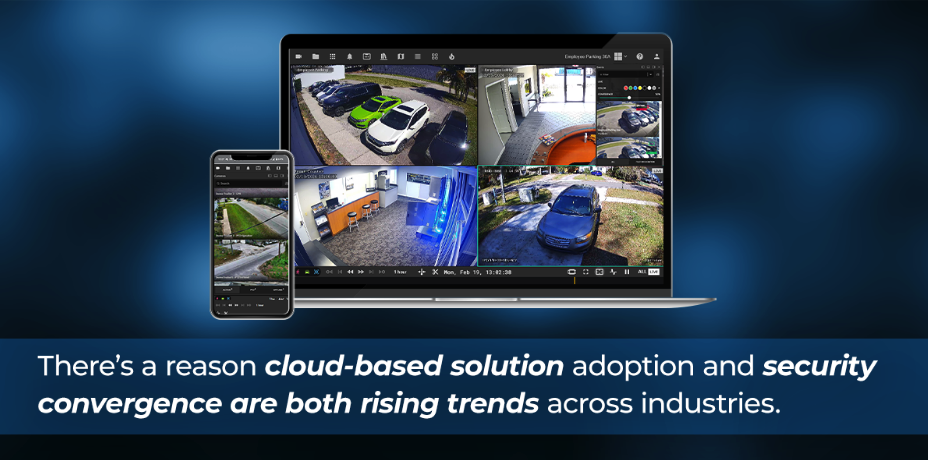
There’s a reason cloud-based solution adoption and security convergence are both rising trends across industries. Convergence can progress more smoothly if security teams use the cloud for managing both cyber and physical systems. Multiple steps must be addressed:
- Integration Ready Equipment: You cannot integrate security systems unless you purchase hardware that is internet-ready so that it shares its graphical digital information (video, alarm I/O) over the internet. Users must ensure that the hardware side is capable for integration into a system beyond the local control environment. That includes hardware ports on cameras, door controllers, and the like, along with protocols to stream such data. Depending on the sensor (camera, door reader) technology, this may require more devices between the sensor and the cloud, or there may be a direct route. As always, such devices need cybersecurity features to prevent hacking at the level of the sensor or with regard to encrypting data to protect streamed data.
- Network: The next step on the cloud highway is the architecture that the data must flow over, and designing a network with proper cable, switches, power requirements, data storage, anti-hacking, and encryption features.
- Software: Data must ultimately hit a piece of software that allows for analysis, alerts, storage, and protection.
- Efficiency: Users will find that the more they integrate into a security integration system, the more synergies they will achieve. For example, if video surveillance is coupled with access control, ultimately less hardware, less software, and less duplication of people will occur. This allows for greater scaling over existing infrastructure, creating more efficiency. Integrating a monitoring system creates more efficiency.
Explore Optiview’s Security Solutions
Optiview has recognized these challenges and provides physical security equipment, software and solutions that allow for clients with multiple locations, or with multiple brands. By utilizing our software management tools that in turn are built to interface with broader networks and systems that manage cyber security protocols helps overcome these challenges. Security exists at every level: cameras and recorders that defend from hacking, encryption technologies that protect data streams. Security convergence allows individuals to view camera feeds across locations that provides an enormous reduction of labor costs. Our systems are developed with advanced trigger technology and communication protocols that allow us to provide you the ability to not only view across an entire set of locations, but to alert key stakeholders when threats are detected. Software management platforms, such as Optiview’s video management software, allow for the integration of more devices (not just cameras, but access-controlled doors and gates, and wide variety of other sensors) which allows you to do more and save more.
Browse our solutions online or contact Optiview for more information on our security solutions.